- Maven Mindset
- Posts
- Issue 11 - What Investors Are Really Looking for Right Now
Issue 11 - What Investors Are Really Looking for Right Now

Angi Milano
January 05, 2026

Hey there!
Fundraising is always top of mind, especially as one year wraps and the next begins. Expectations are sharper, timelines feel longer, and clarity matters more than ever. Founders are being asked to show real progress, not just potential, and to explain their business with precision instead of polish.
This month’s spotlight looks at what that actually means in practice, from the perspective of someone who sees these decisions up close every day. I caught up with JD Audena from Connetic Ventures to chat about what investors are really focused on right now, where founders tend to get tripped up, and how the rules of fundraising continue to evolve.

What Investors Actually Care About Right Now
As part of my advisory work, I talk with founders every week who are navigating fundraising in a very different market than the one we saw just a few years ago. The questions are consistent. What are investors really looking for right now? How do you stand out when capital feels tighter and expectations feel higher?
When you talk to JD, it becomes clear why founders trust him. He combines analytical rigor with an ability to explain what is actually happening behind the scenes in venture, without hiding behind jargon or theory.
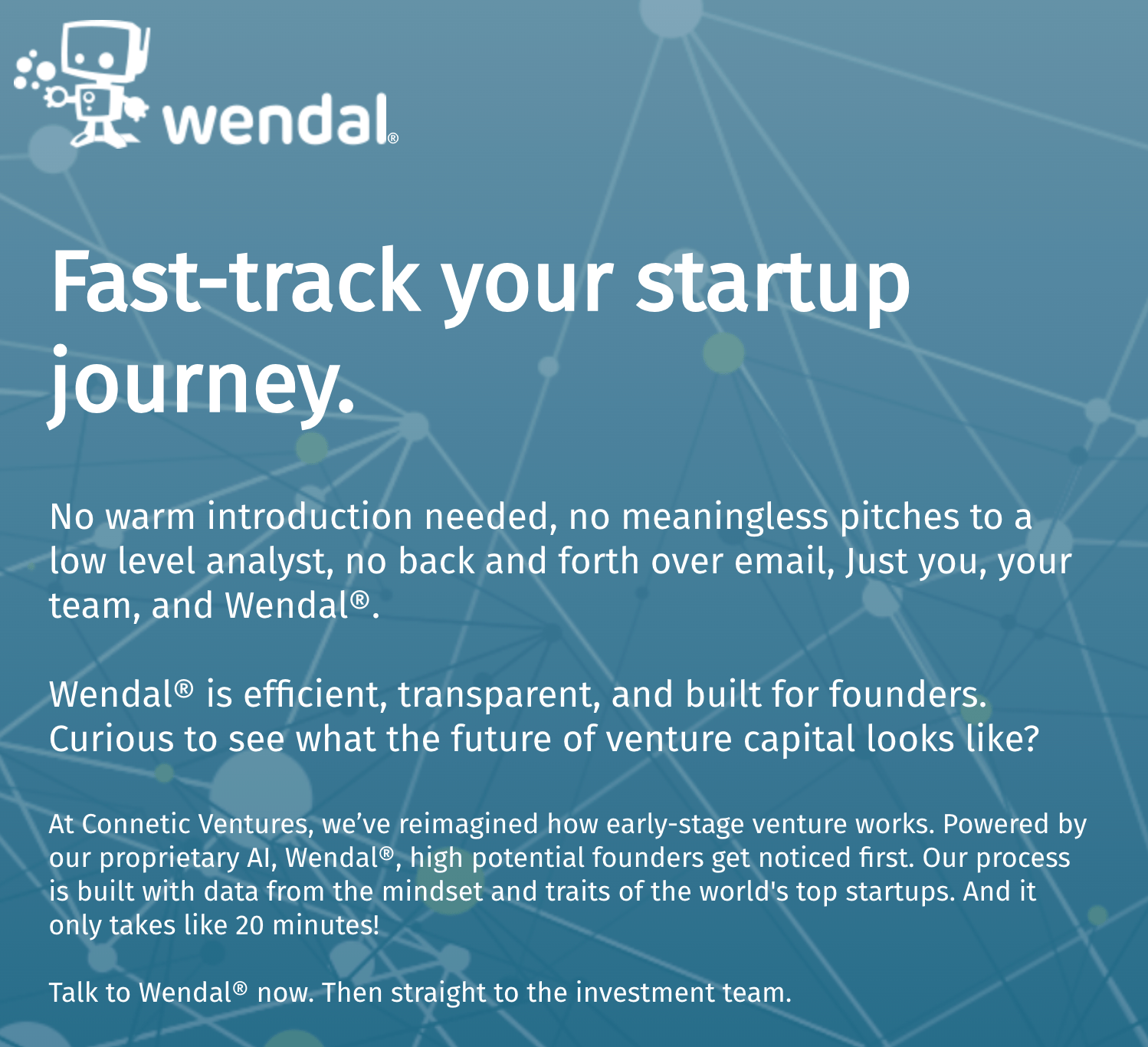
At Connetic, JD and his team take a different approach to early-stage investing by using AI to bring more consistency and fairness into how companies are evaluated. Their proprietary platform, Wendal, is designed to reduce the advantage of polish and proximity by structuring information, assessing evidence across multiple dimensions, and surfacing signal that might otherwise be missed.
Instead of relying only on warm introductions or subjective first impressions, Wendal supports a more repeatable and data-informed vetting process. AI helps normalize inputs, identify patterns, and highlight areas that deserve deeper human judgment. As JD puts it, “AI gets a voice, not a vote.” The goal is not to replace investor intuition, but to strengthen it with better signal and clearer context.
For founders, this approach matters. It means access is less dependent on who you know and more dependent on what you have built, how your team operates under pressure, and whether real evidence of progress exists.
Below are a few highlights from our conversation.
What investors are focused on now
JD was clear that the bar has moved since 2021. Vision and charisma alone are no longer enough.
“In 2021, founders could win with vision and charisma alone. Today, data infused narratives with clear proof points are non-negotiable.”
He emphasized that early founders need to focus on building what he calls evidence of inevitability, including:
“Customer pull — retention, expansion, proof of urgent pain
Capital efficiency — clear burn logic and runway discipline
Distribution clarity — who buys, why now, and how you reach them repeatedly
Foundational gravity — the inherent value your business has independent of investment capital.”
How positioning has changed in an AI-driven market
According to JD, standing out today is less about describing opportunity and more about showing how you’ve learned and adapted.
“In the era of AI, the teams that win are the ones who show they can capitalize on the opportunity, not just describe it.”
He pointed to a simple posture that is resonating with investors right now:
“Here’s what we believed, here’s what customers taught us, and here’s what we changed.”
Investors are rewarding teams that demonstrate tight learning loops, distribution clarity, and the ability to hit real milestones within their current capital structure while preserving long-term upside.
Common mistakes founders still make
JD sees the same patterns show up repeatedly in early-stage fundraising conversations.
“Founders spend too much time on the story and not enough on buyer reality: ICP clarity, sales cycle truth, retention signals, and pricing power.”
He also cautioned against confusing motion with progress:
“ ‘Partnership conversations,’ ‘pipeline,’ and ‘interest’ don’t land like they used to. Investors want proof you can turn attention into revenue or at least into conversions.”
And finally, a reminder many founders still learn the hard way:
“Founders should run fundraising like pipeline management: multiple conversations in parallel, consistent momentum, no serial waiting between pitches.”
How Connetic uses AI differently
Connetic’s approach is built on the belief that talent and capability are evenly distributed, but access is not.
“The ability to be a founder or startup team member who can generate positive, return-generating outcomes is evenly distributed—but the opportunity is not.”
Wendal, was designed to introduce a more consistent and evidence-based evaluation process. AI helps normalize inputs, surface patterns, and reduce bias, while human judgment remains central to investment decisions.
One piece of advice founders should remember
If founders take away only one thing from this conversation, JD was unequivocal:
“Don’t optimize for fundraising. Optimize for building something customers feel they can’t live without.”
He added that exceptional businesses still get funded, regardless of background, network, or geography, and that focusing on becoming exceptional is the most reliable path forward.
Founder Checklist: What This Means in Practice
Pulled directly from JD’s insights, here is a simple checklist founders can use to pressure-test readiness.
Can you show real customer retention, expansion, or urgent pain?
Do you have a clear burn narrative and runway discipline?
Can you explain who buys, why now, and how you reach them repeatedly?
Are you demonstrating learning loops, not just conviction?
Are you converting interest into revenue or measurable progress?
Can you clearly articulate what makes your business valuable independent of scale?
Are you managing fundraising like a pipeline, not a waiting game?
Practical GTM Strategies: Fundraising Starts Before the Pitch
Fundraising works better when investors already understand how you think and what you are building. Clarity and consistency do more work than a polished deck ever will.
Here is what actually helps:
Be clear about your focus. Say exactly what you are building, who it is for, and why it matters. Ambiguity slows interest.
Show real progress. Share lessons from customers, pilots, or product decisions. Evidence builds trust faster than vision alone.
Share how you learn. Investors pay attention to teams that can explain what they believed, what they learned, and what they changed.
Stay visible and consistent. Momentum comes from showing up regularly, not from a single announcement when you are ready to raise.
The strongest fundraising conversations usually start long before the raise. When done well, your presence creates context, credibility, and pull before you ever send the deck.
Sales & Marketing Tips: Amplifying Wins Matters More Than You Think
Clear wins do more than validate your work. They make your story easier to tell, your sales conversations easier to start, and your company easier to believe in.
Here is how to use wins well:
Name the win clearly. Be specific about what actually happened. What problem was solved, for whom, and why it mattered. Vague success does not travel far.
Tie the win to impact. Focus on outcomes, not effort. Show how the result changed a customer’s reality, not how hard your team worked to get there.
Share it consistently. Wins should show up in sales conversations, marketing content, and investor updates. Repetition builds confidence and reinforces progress.
Use wins as proof points. Let real examples support your narrative instead of relying on future plans or big ideas. Evidence builds trust faster than ambition.
Reflect on what worked. Wins are signals. Pay attention to what made them possible so you can repeat the conditions, not just celebrate the outcome.
Teams that take the time to amplify wins make it easier for prospects to say yes and for investors to see progress clearly. Success only compounds when people can see it and understand it.
Press Play: Inside The GTM Loop
🎧 Listen here: Spotify, Apple Podcasts, YouTube, or Web
That’s it for this issue of Maven Mindset. If you’ve been looking for a strategic partner who brings clarity and real-world experience, you’re in the right place.
If this resonates with you, let’s chat! And if it was helpful, remember to share! ✌🏼🩷
Until next time,
Angi
P.S. Hope is not a strategy.
Reply